
CASE STUDIES
Fish Walls • Suspended Reef Ecologies • Habitat Complexity
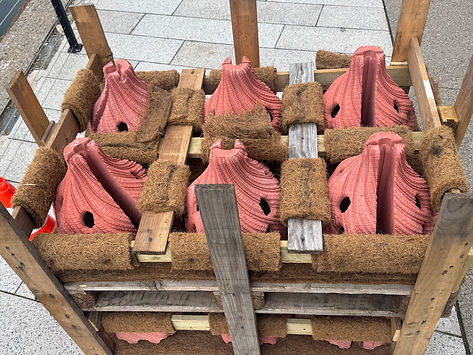
Shelter Shells are biomimetic underwater habitat structures designed to bring complexity back to simplified aquatic environments. Inspired by shells, crevices, rock pools and other natural refuge features, their rough, crenulated surfaces and sheltered apertures provide additional surfaces and spaces for fish, bivalves, invertebrates and other aquatic life to colonise, shelter, feed, breed and grow. Typical shell forms are approximately 300–500 mm in diameter and can be deployed individually, placed on the substrate, or suspended in vertical arrays.
When arranged along quay walls, beneath pontoons, under floating wetlands or from existing marine structures, Shelter Shells can form underwater “Fish Walls” or suspended reef ecologies. These systems extend habitat through the water column, adding three-dimensional structure to places where hard edges, lined basins or featureless substrates otherwise provide few ecological niches. The case studies below illustrate applications across freshwater, estuarine, Atlantic, Pacific and tropical marine environments.

57 Shelter Shells in Commissioner’s Quay in Blyth with Groundwork's Revitalising Our Esturaries programme. In this tidal location, they are submerged underwater at different tidal times and visible to the public at low tide. They cover 15m across and 4m down and hang from horizontal beams within Commissioner’s Quay.
Shelter Shells were installed in a lagoon in the Eden Project’s Emergence Zone in Cornwall, where they are conducting research on this new type of underwater habitat.


As part of the Eden Dock project at Canary Wharf, a range of underwater habitat features were installed to complement the extensive floating wetlands that form the main park ecology.
An array of Shelter Shells was installed beneath a pontoon access quay at Fort Point in central Boston, just inland from the Boston Tea Party Museum. Working progressively with the falling tide, the team suspended the shells beneath the structure, introducing complex underwater habitat into a waterway otherwise characterised by substantial historic granite walls.


A series of Shelter Shells was installed within Whitby Harbour as part of a wider programme commissioned by Groundwork North East & Cumbria to enhance habitat within a heavily modified estuarine environment. The Shelter Shells were installed alongside Vertipools and other habitat features from Artecology, creating a diverse range of artificial refuges, textured surfaces and ecological niches around the working harbour.
A pilot Shelter Shell installation was established at Dahab on Egypt’s Red Sea coast, suspended beneath a marker buoy over an area of predominantly sandy seabed. Although the wider Red Sea supports highly diverse tropical reef ecosystems, the immediate location offered little hard substrate or structural complexity for corals and other reef organisms to colonise.


This is your Project description. Provide a brief summary to help visitors understand the context and background of your work. Click on "Edit Text" or double click on the text box to start.
Shelter Shell halves have been installed within the Wild Mile in Chicago, integrated into the shallow-water zones created by the project’s suspended floating wetlands. Positioned directly on the shallow substrate, the shells provide additional refuge for small fish and aquatic invertebrates as they move through and forage within these protected areas.

Across these projects, the core principle is consistent: increase habitat complexity where conventional waterfront infrastructure or simplified substrates have removed it. Shelter Shells can operate as individual refuges, substrate features, Fish Walls or suspended reef ecologies. Used alongside floating wetlands, salt marshes, Biohuts, Vertipools and other ecological infrastructure, they help connect surface, mid-water and bottom habitats into a more varied aquatic landscape.